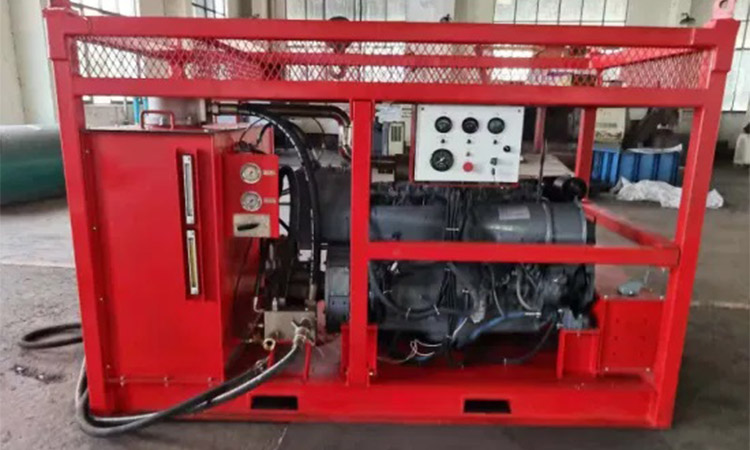
Oil drilling tools
Oil drilling and production equipment is a key tool for exploring and developing underground oil and gas resources. Its efficient and safe operation relies on the coordinated work of thousands of precision parts. These seemingly inconspicuous parts are like the "joints" and "blood vessels" of the machine, forming the cornerstone of the entire drilling and production system. This article will systematically introduce the functions, materials, and characteristics of some core components in oil drilling and production equipment.
I. Drill Bits and Cutting Teeth
Drill bits are the parts that directly contact the underground rock formations and are responsible for breaking the rock. Depending on the geological conditions, they are mainly divided into roller cone bits, PDC (polycrystalline diamond composite) bits, and diamond bits.
1. Roller Cone Bits: These have multiple rotatable conical roller cones with carbide teeth embedded in their surfaces. Under drilling pressure and rotation, the roller cones roll, impact, and crush the rock, suitable for medium-hard to hard formations.
2. PDC Bits: These use polycrystalline diamond composites as the cutting element. These composite blades are fixed to the drill bit body and break rocks by scraping, featuring high mechanical drilling speed and long service life, especially performing excellently in soft to medium-hard formations.
3. Cutting Teeth: Whether it's carbide teeth or PDC blades, material science is crucial. They require extremely high hardness, wear resistance, and a certain level of impact toughness to withstand complex underground stresses and high temperatures.
II. Drill String Assembly
The drill string is the "drive shaft" and "channel" connecting surface equipment and the downhole drill bit, composed of a series of thick-walled steel pipes and special parts.
1. Drill Pipe: The main component of the drill string, used to transmit torque and deliver drilling fluid. It has thickened joints at both ends, interconnected by threads.
2. Drill Collars: Located between the drill pipe and the drill bit, they are thick-walled seamless steel pipes, primarily providing drilling pressure, ensuring stable drill bit operation, and enhancing the rigidity of the drill string.
3. Square Drill Pipe: Located at the very top of the drill string, with a square or hexagonal cross-section, it mates with the square mandrel in the rotary table to transmit the rotational power of the surface rotary table to the entire drill string.
4. Connectors and Tool Connectors: Used to connect different components. Their thread type (e.g., API standard thread) is precision machined, requiring good sealing and fatigue resistance to prevent disengagement or leakage under high pressure.
III. Wellhead Equipment and Blowout Preventer Assembly The wellhead equipment.
Installed on the casing head, is crucial for controlling well pressure, guiding drilling fluid outflow, and subsequent production operations. The blowout preventer assembly is its core safety component.
1. Casing Head: Supports the weight of all subsequent wellhead equipment and the casing string, and provides a seal and outlet for the annulus between the casings.
2. Blowout Preventer: Typically a multi-gate structure. Its core components include a large housing, gates (a full-sealing gate closes the empty wellbore, a shearing gate cuts and seals the drill pipe; a semi-sealing gate grips and seals the drill pipe), piston rod, and a hydraulic control system. 3. **Choose and Kill Valves:** Used in conjunction with the blowout preventer (BOP), these valves precisely control the opening degree to regulate well pressure and perform well control operations after the BOP is closed.
IV. Key Components of Downhole Tools
To perform specialized operations such as directional drilling, coring, and cementing, a series of complex downhole tools are required.
1. Rotor and Stator of a Screw Drill String: This is a downhole power tool. Its core is a motor composed of a rotor and stator. The stator is a rubber bushing with a double-helix inner cavity, and the rotor is a steel single-helix rod. High-pressure drilling fluid drives the rotor in planetary motion within the stator, converting fluid kinetic energy into mechanical energy, directly driving the drill bit rotation.
(Note: The text also mentions choke and kill valves, but these appear unrelated to the main topic and are likely separate points.)** 2. Measurement While Drilling (MWD) Tool Sensors and Circuits: These precision instruments contain various sensors (such as accelerometers, magnetometers, pressure sensors, and gamma sensors) and high-temperature, high-pressure resistant circuit boards. They are used to measure wellbore inclination, azimuth, tool face, and formation characteristics in real time, and then encode the data and transmit it to the surface via drilling fluid pulses or electromagnetic waves.
3. Cementing Plugs: Isolation components used during cementing operations. Typically made of materials such as rubber or aluminum cores, they are inserted into the casing before and after cementing to isolate the drilling fluid from the cement slurry, scrape away mud film from the inner wall of the casing, and provide a signal indicating the completion of the operation upon impact.
V. Pumps, Valves, and Fluid Control Components
The drilling fluid circulation system is like the "circulatory system" of the drilling rig, with pumps and valves being the core components.
1. Drilling Pump Hydraulic End Components: These include cylinder liners, pistons, piston rods, valve boxes, suction valves, and discharge valves. These components operate under high pressure (up to tens of megapascals) and the scouring effect of abrasive drilling fluids, requiring extremely high wear resistance and corrosion resistance. Valves and valve seats are typically made of special alloy steel and hardened.
2. High-Pressure Manifolds and Valves: High-pressure resistant steel pipe systems connecting pumps, risers, and faucets. Gate valves, plug valves, etc., on these require reliable sealing structures and powerful actuators to precisely control the flow direction and on/off state of high-pressure fluids.
VI. Materials Science and Manufacturing Process Characteristics
The harsh operating conditions of oil drilling and production equipment parts place special demands on their materials and manufacturing processes.
1. Material Selection: High-strength alloy steels (such as AISI 4140, 4130), stainless steel, nickel-based alloys (for highly corrosive environments), as well as hard alloys, industrial diamonds, special rubbers, and engineering ceramics are widely used. Materials must meet comprehensive performance requirements including high strength, high toughness, wear resistance, corrosion resistance, and high-temperature resistance.
2. Key Processes: These include large forging (e.g., blowout preventer housings), precision deep hole machining (e.g., drill collar inner bores), special thread machining and measurement, surface hardening treatments (e.g., nitriding, wear-resistant weld overlays), rigorous flaw detection (e.g., ultrasonic and magnetic particle testing), and targeted heat treatment to resist hydrogen sulfide stress corrosion.
Oil drilling and production equipment parts constitute a complex collection of high-tech products involving multiple disciplines. The reliability and performance of each part directly affect the efficiency, cost, and ultimate safety of drilling operations. Behind them lies a deep integration of materials science, mechanical design, precision manufacturing, and stringent quality control. As oil and gas exploration and development move into deeper strata, more complex environments, and the ocean, the performance requirements for these parts will continue to increase, driving the continuous advancement of related technologies.